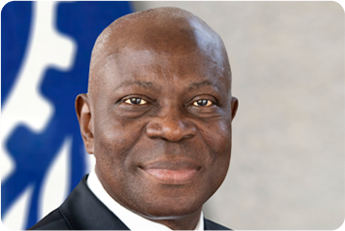
Gilbert F. Houngbo, born in Togo in 1961, has dedicated much of his life to enhancing the prospects of the world's most vulnerable people. His extensive experience in policy issues, economic development, diplomacy, and financial accountability has been instrumental in his mission.
After earning an advanced degree in business management from the University of Lomé (Togo), Gilbert F. Houngbo obtained a degree in accounting and finance from the Université du Québec à Trois-Rivières (Canada) and became a member of the Canadian Institute of Chartered Professional Accountants.
He commenced his professional journey at Price Waterhouse in Canada in 1986, where he remained until 1993. Subsequently, between 1994 and 1996, he served as the Director of Finance at the International Bank of Mali. Following this, he joined the United Nations Development Programme (UNDP), assuming various roles including Head of Financial Reporting and Trust Fund Management, Comptroller and Director of Finance and Administration, Chief of Staff, and Assistant Secretary-General and Regional Director for Africa.
In 2008, Gilbert F. Houngbo was appointed as the Prime Minister of Togo, a position he held until 2012. He reengaged with the United Nations system in 2013, taking on the role of Deputy Director-General for Field Operations and Partnerships at the International Labour Office.
In 2017, he was elected as the sixth President of the International Fund for Agricultural Development (IFAD), and in 2021, he was re-elected to the same post. Since 2017, he has also served as the Chair of UN-Water, the United Nations' coordination mechanism for water and sanitation.
Additionally, Gilbert F. Houngbo chairs the Board of the Natural Resource Governance Institute (NRGI) and is a board member of the International Center for Biosaline Agriculture (ICBA).
In March 2022, Gilbert F. Houngbo was elected by the ILO's Governing Body as the Organization's 11th Director-General, becoming the first African to hold this position. He assumed this role on October 1, 2022, with a focus on promoting greater social justice, combating inequalities and discrimination in the world of work, and improving working conditions through national action and effective multilateral coordination and leadership. His priorities include universal social protection, decent work in global supply chains and the platform economy, the fight against child and forced labor, protecting the rights of migrant workers, promoting social dialogue and freedom of association, ensuring just transitions, and achieving gender equality.